
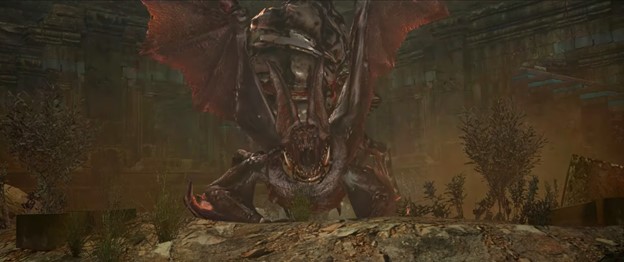
A dangerous area filled with sun heat-ray puzzles, a room with wicker balls to beset on fire and rolled, and collapsing ceilings, the underground ruins became a comfort. The webbed paths require traversing up bridges and stone steps. RE succeeds in these types of set pieces. A major one triggers after activating a tall staircase, just for the Popokarimu, a B.O.W. (bio-organic weapon) mix between a bat and a larva, to flap its wings down from above and stand in the way.
On the other hand, Enter The Matrix invokes a time period that can best be described as a phase. A green-tinted phase that is both ridiculous and charming in its genuine eagerness to be taken seriously. Like a mythical child raised on Knights of the Old Republic over Star Wars proper, the crew of the Logos: captain Niobe, right hand man Ghost, and tech support Sparks were my Nebuchadnezzar. In hindsight, it should not be so novel to play a videogame where the two protagonists were a black woman and an east-Asian man (clearly, I was neglected by not being raised in a Ballistic: Ecks vs. Sever for the GBA household).
The two protagonists’ stories start to diverge in the second half, which as mentioned earlier, sections were prioritized to avoid driving. Ghost, the calm gun specialist, never had to drive the cars like captain Niobe, so his campaign got replayed more often. His sewer section is an oddly quiet sniper-focused stealth segment. He climbs ladders down to a hanging structure in the middle of a bottomless pit, where SWAT teams can be taken out from afar or flipped over the railings from behind. To compensate for the grimness of that previous sentence about strategically shooting people, Enter the Matrix has the ability to run up a wall and do a flip, which is both goofy and impractical. A list of video games without sewers would be shorter than one that includes them, so for one to stand out like this one did must mean something.
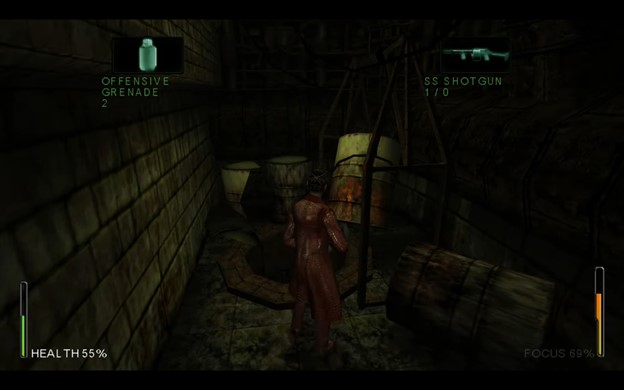
In more dour Ghost sniper adventures, a mission to plant an explosive at a nuclear power plant involves more construction site travel than is ever necessary. Gray concrete walls and wooden pallets are almost as common to video game set pieces as sewers, so why were these indistinguishable landscape features so novel compared to, say, the construction in the second half of Max Payne? This nuclear power facility doesn’t even have something as memorable as May Payne’s famous locked door. It might have to do with introducing me to covering an ally as a sniper. Ghost covering Niobe through the massive construction site might be why I tend to swing back and play snipers in shooters. Once again, to break up having to write about shooting a gun, Enter the Matrix has a hidden fighting game mode where anthropomorphized cars punch and kick each other.

To end on a game that does not involve detailing ways to kill people with realistic firearms (but unfortunately lacks any black women protagonists), is the Lord of the Rings: Return of the King. An adult return to what was once a solid action game revealed more padded skill point grinding than pure enjoyment. Nowadays, this sentiment is echoed in the simple joy of co-oping a musou game, but there was something special about taking two Lord of the Rings warriors to fight a horde of orcs. One level involved fighting up to, over, and through a gate to Gondor. From being pushed back by a cave troll on a bridge, to collapsing a tower with a trenchant, to climbing up said tower to pour boiling oil over the gate entrance; this sequence of flowing action moments was played again and again.

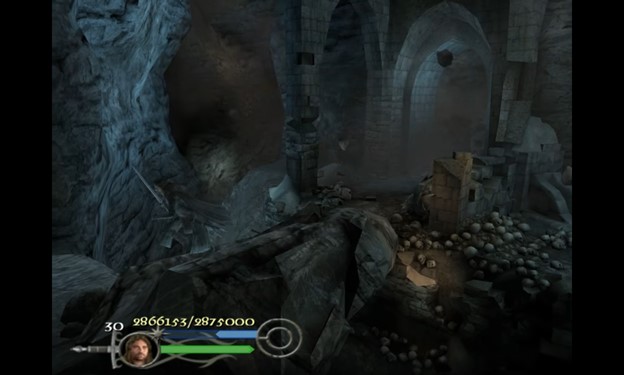
Second to the gate was a part of Aragorn, Legolas, and Gimli’s story that, even in the film’s extended cut, was only given a few minutes. This event was their side quest to enter the Dwimorberg cave to gain the assistance of the Men of the White Mountains, green ghosts kept from the afterlife by Isildur’s curse, to protect the plains of Gondor from Saruman. This action game turns into a dungeon crawl to an angry ghost king and ends with a race out before the cavern collapses. A major memory was the waist-deep, or in Gimli’s case neck-deep, fog.
As an individual who reads and writes while listening to multiple hour loops of space heaters or nonsense like the Jason Bateman synthwave meme song, repetition can be relaxing but also focusing. Replaying these areas must have maintained a similar vibe, like how some people enjoy keeping the same few movies on in the background while doing laundry, or that one summer as a kid I kept rewatching Dragon Heart and Batman Forever. No real definitive conclusion, but it is interesting what people will imprint onto their memories.
 Oddity Games
Leave a comment