
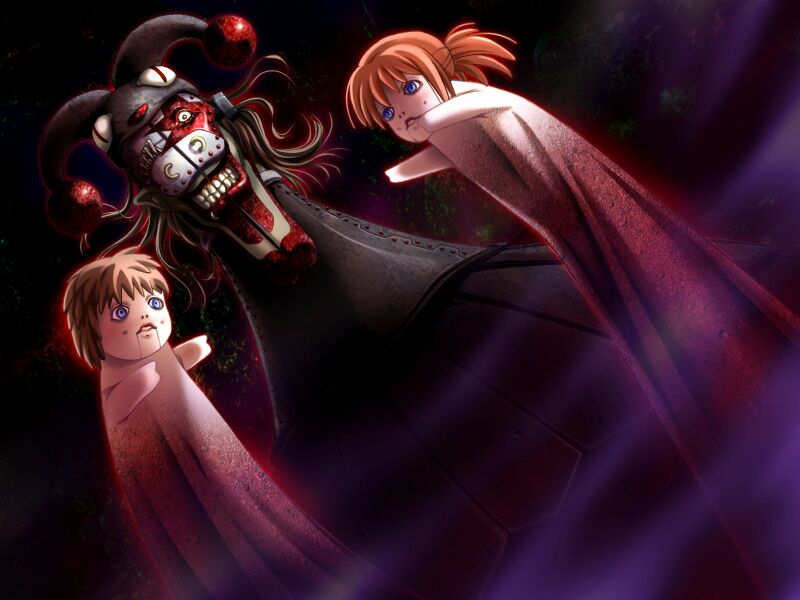
Gore Screaming Show, past its infamous trailer, police tape warning main menu, and gory sex scenes is about two different themes. One is a coming-of-age story for high school senior Kyouji Jinno, as he adjusts to living with his cousin while returning to his small rural hometown. The second is about asking the hypothetical question, one spoken almost verbatim by the trench coat and cigarette-smoking older adult with a gun Yoshiki Yatsuse (a recognizable archetype in horror visual novels), “should you forgive the vile actions of a person who is also the victim of vile actions?”. This question is posed to tiny child Yuka and her Freddy Krugger/Pinhead clown playmate Gore Screaming Show, the creative and destructive force that is intended to forever change Kyouji’s life. The problem arrives when Kyouji’s role as player character inoculates him from the true physical and mental trials horror characters should experience.
Entire books have been filled about the narrative unpleasantness of misogynistic fiction wherein men go on emotional journeys while only the women in their lives experience violence and malice. Gore Screaming Show is often about Yuka and Gore Screaming Show terrorizing Kyouji by assaulting his female classmates or killing the people around him. Kouji often does not feel as if he is in harm’s way. as his main value to the horror, Yuka, is romantic or as a prize. Outside of potential social isolation, Kouji as a horror protagonist has it rather easy. Better horror visual novels are more interesting because their protagonists are forever changed, if not disfigured by the horror.
The few horror visual novels of merit understand this. College student Fuminori Sakisaka in Song of Saya spends the entire game trapped in a living hell where everything is covered in meat and gore, besides the real monster, little girl Saya. Fuminori, no matter what few choices the player is given, is not going to be able to escape this unfair torment. Youji Sakiyama, the sickly senior of Sweet Pool, is victimized by just about everyone. From being the sex-slave of the heir to a dying yakuza clan, to becoming the dinner of a food-focused friend, Youji goes through some shit. One of the quote-unquote best endings in Sweet Pool is that Youji gets to die helping give birth to a new life-form cocooned in a pool of blood.

Physical trauma is not even necessary, as a strength of the visual novel is that a single character can end up going down drastically different paths. Gore Screaming Show keeps its bad endings within these un-canon distractions into gorn rape scenes with Kouji’s love interests, instead of doing interesting “what if” scenarios. Two popular Otome games, Code Realize and Collar x Malice, each have fantastically dark and sad potential endings. One Code Realize bad ending, protagonist Cardia must join Idea, a millennia old secret organization that requires her to become an Apostle, thus living and serving them forever. Officer Ichika Hoshino in Collar x Malice has a bad ending in a romantic route, where instead of helping the love interest escape the people who brainwashed him into becoming a hitman, Ichika fails and ends up joining him as another contract killer. Bad endings do not need to be fifteen instances of the protagonist getting stabbed in a dark alley, but can be allusions to terrible fates. Kouji is never vulnerable or victimized to this degree. I want to experience someone process something personal by being forced to confront unknowable horror, and in turn, be changed forever. Gore Screaming Show treats many of the endings as a wacky school adventure. If Kouji is never in any real danger, I, the reader, am also left unmolested.

Horror allows unusual figures to compete against each other in a way that other genres usually cannot. Simply, and this is not always necessary, a monster is needed. Clive Barker’s first full novel, The Damnation Game, is about the lengths old men will go to maintain their crumbling legacies, but it is also a book energized by an undead child murder and his centuries-old sorcerer master who is afraid of dogs. Yuka and Screaming Gore show are sadly the underutilized monsters of Gore Screaming Show. Gore is Yuka’s pet but also her only friend. There exists an odd joy in seeing a small child make demands of a ten feet tall specter. When the narrative isn’t trying to shoe-horn that Gore is horny-on-main, he’s an evil kid’s show host with lessons and puns. I personally do not subscribe to the slasher premise that I just want to see lousy people get killed, but when the violence in Gore Screaming Show is often so fixated on sexual violation, Gore driving someone down with a magic ghost truck is a relief. Gore even works in the first few hours of the game as this hungry evil spirit that kidnaps people in the night, a modern reinterpretation of the small town’s ancestral history with demons. Like Saya from Song of Saya, Yuka and Gore do seem to live beyond the reaches of their game but feel wasted in Kouji’s boy-grows-into-a-man story.
Horror visual novels are a mine I have found diamonds in before, but the real growing dread is that I might have already mined out the single vein. Frequent comparisons to books are necessary because of the time investment visual novels demand with their lengthy attempts at world building and slow plotting. As someone who finds books quicker to read than visual novels and that both are appropriate spaces for tales of frights with bites, my expectation that visual novels use their format to present interesting horror is a request I should not have to stress over.
 Oddity Games
Leave a comment