
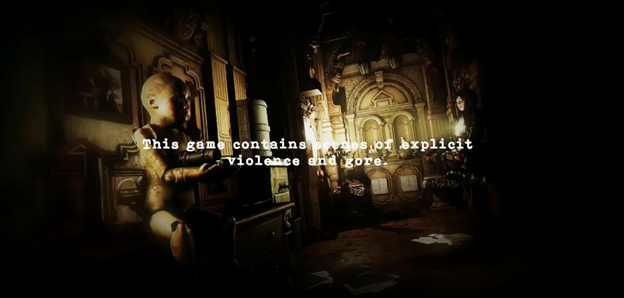
Tormented Souls could have been a better game. Dual Effect captured important visual and mechanical parts of PS1 and PS2-era survival horror, with Tormented Souls’ fixed camera angles and narrow hallways. But narratively, it’s a story of escaping an old hospital/mansion/church/research facility that never reaches the height of older-era Silent Hill or the environmental storytelling of the first three Resident Evil games. What Tormented Souls did have, though, was perhaps the most necessary element, a “This game contains scenes of explicit violence and gore” start-up warning screen.
Like the comforting and often remixed startup logo drop of the Game Cube, the horror game warning screen invokes a nostalgic bygone. A proper warning screen is the first snapshot of survival horror. These images can be broken down into two types: still shots of backgrounds with ominous vibes, and simple portraits of a character mid-combat. Capcom is most attributed to using these relics. A ten-minute google search did not provide an answer to whom or why these disclaimers were necessary. Backgrounds, like the Resident Evil 2 screen of the Raccoon City Police Station or the castle from Haunting Grounds, are good examples of a term I use when discussing horror, which is utilizing the “bad place”.

The term needs work (I never claimed to be a linguist), but “bad places” are locations, usually single rooms but the definition can apply to buildings that the viewer or reader knows is dangerous. It can also be a place where great violence has happened and the characters either coexist alongside the location or arrive there later. The classic example is the attic of the sorority house in 1973’s Black Christmas. At the start of the film, the unnamed killer brutally suffocates a student with a plastic bag, then perches her in a rocking chair barely noticeable from the outside window. Over the course of the film, the students and the alcoholic den mother of the sorority house simply think the first student left early for Christmas break. Everyone is unaware that the floor above is becoming a spider’s den of victims, with a killer waiting.
A good example is the secret, burned-out top of the Cabrini Green apartments and its open mouth graffiti in the original Candyman. The massacred submarine in Dead Space: Martyr is another demonstration, wherein the protagonist deep dives to find the lost sub which the reader knows is filled with the remains of its crew, and this was the only time Dead Space successfully scared me. The unawareness of the characters and not knowing what horrors are past the door, like the ones the Raccoon Police Department hold for Leon Kennedy and Claire Redfield in RE2 and for Jill Valentine and Carlos RE3, is where the real terror resides.
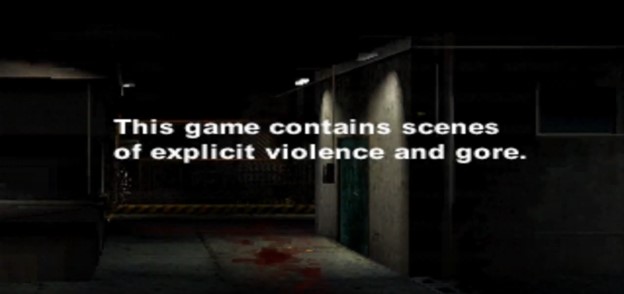
The original Dino Crisis has a more direct example in its warning screen. Arriving at night on a deserted island base, special agent Regina and a bunch of guys who don’t show up in the sequels need to break in and rearrest an allegedly dead secret weapons scientist. Dino Crisis foreshadows the grim reality of the hidden laboratory by showing the blood-covered walkway to the lab security room before the game even starts. Hungry dinosaurs with sharp teeth and pointy claws await Regina and company, and as the warning screen shows, the dinosaurs already got a head start.
In a more comical than ominous approach, Capcom used the horror game warning screen for both Devil May Cry 3 and God Hand. Dante’s office does experience some rather explicit destruction in the beginning and Dante himself seems to be performing violence to the screen in the warning screen, but it feels more intentionally self-aware than serious.
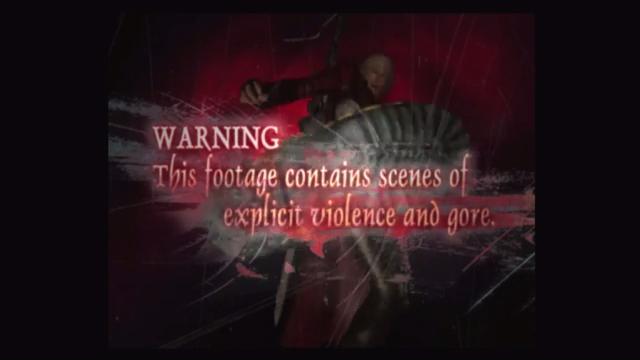
God Hand’s inclusion into this hollowed gallery might be more of an inside joke by director Shinji Mikami, whose previous works Resident Evil and Dino Crisis already set the trend. Maybe he felt that protagonist Gene’s goofy bicycle kick into a mohawked thug’s groin, an ironic move for a man who possesses the God Hands, denoted explicit violence.

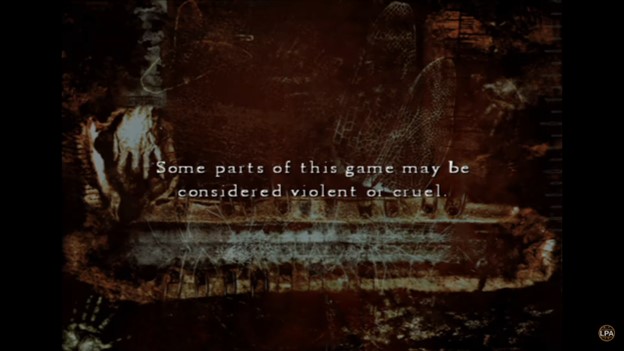
Silent Hill takes Capcom’s weird warnings and makes them inspired by rewriting them as “Some parts of this game may be considered violent or cruel”. The warning screens in SH 1 and 3 (2 for some reason lacks one) are of the character in mid-combat. Heather Mason’s post club swing to an unrecognizable mass is visceral, but more action-focused than creepy. SH 4’s by comparison is an abstract piece of grungy art. A collage of dispirit images, from dragonfly wings to a handprint, look less like a game screenshot and more of a background photo. The brown and silver rectangle at the bottom could be anything, and that’s what makes it so unnerving.
In the modern era, the horror game warning screen continues not as a mandatory requirement, but as homage. The Resident Evil Modding forum adds a custom warning screen to Resident Evil Village. The tabletop rpg Enter the Survival Horror uses the game as a subtitle. Even recent games Ultra Kill, Daymare, and Deadeus, like Tormented Souls, include their own interpretations. The warning screen is shorthand for an earlier time where survival horror was more prevalent, but it’s become a tradition that continues today, one maintained by the people who grew up with these games.

 Oddity Games
Leave a comment