
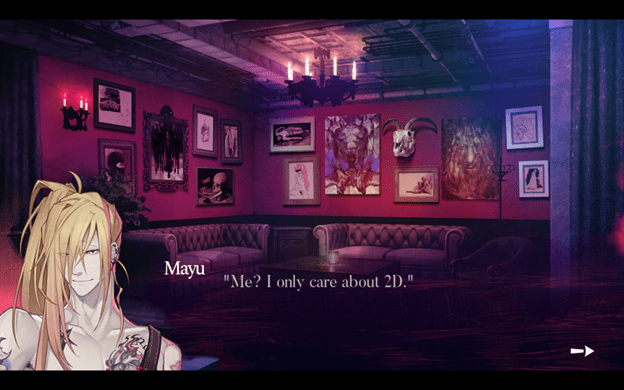
Slow Damage (more like Slow Burn) does not drop the shoe as to what it is about until the end of the first chapter. Allusions are fair, but key details will ruin the mystery. Without giving too much away, Towa is a famous underground artist who picks people to model his portraits. Best described by multiple characters as a stray cat, Towa is a chain smoking and heavy drinking misanthrope kept alive by his “dad friend” Dr. Takuma Murase and “mom friend” Izumi Rei. The slowly beating heart of Slow Damage is what it must be like to have to sit next to Towa at his favorite late-night bar, Roost. Roost is relaxing, with its violet and navy lighting and walls covered in abstract art of naked bodies or skulls. While vibing at the counter, drinking and listening to Roost’s owner talk about life, Towa is blowing his cigarette smoke in your face. Slow Damage is, if nothing else, a story about sleaze, nicotine, bruises and how people survive in between.
Found more often in detective games, Slow Damage is broken into exploration sequences to different Shinkoumi districts to talk with an extended cast of yakuza goons, bar hosts, and the Nitro Chiral staple, an old lady who runs a candy shop. The other type of communication is interrogation, wherein Towa uses found word prompts to get answers out of people, working like chapter bosses. Both systems work on confusing “positive” versus “negative” replies. It harkens back to when people played L.A. Noire and its Australian language barrier problem resulted in interrogations ending abruptly because people accidently pressed the “escalate to punching” button. No harm in a VN trying to shake up interactions, like Steins Gate’s text messaging and Collar X Malice’s annoying shooting mini game. However, while presenting clues is rarely a brain teaser (and does not cause a failed state), the “positive” versus “negative” system feels arbitrary. Watching Towa meet up with someone late at night, just to go “yeah, fuck this, I’m taking my violence ball home” and repeatedly leave killed the tension. Since the game’s four routes are almost made to be done in a certain order, with some needing to be unlocked, a thirty plus hour kinetic novel would have been a lot to ask of a player.
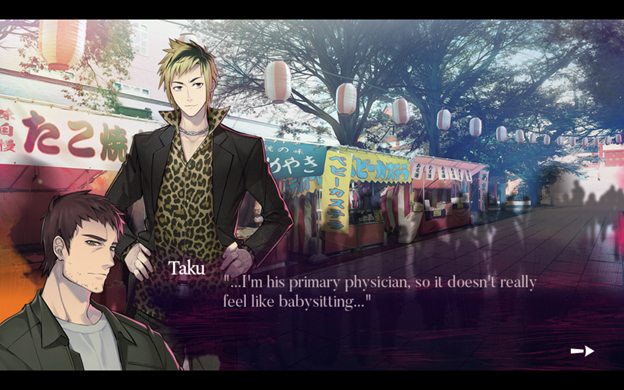
Mechanical problems aside, Slow Damage does two things, one that is sadly not more common and the other that is a real achievement; both can be summarized with the word characterization. Interesting, or simply fleshed out characters are why I play VNs. Towa is the only big budget (for VNs at least) protagonist that is genuinely engaging. To be blunt, Nitro Chiral VNs are games where a naïve bottom gets topped by a line of numerous character tropes, but with effort put into an overarching narrative. Slow Damage is about overcoming trauma…or unhealthily leaning harder into it. Personalities, especially unlikeable ones, get in the way of being the object of attraction for totally disparate hot men. Towa, on the other hand, is a giant mess who takes medication with room-temperature beer and eats only when fed by others. He’s direct in a way that comes off as cruel and moralistic, and detached with even his closest friends. Towa would suck more if he was not eventually self-motivated to protect someone from being beaten up in the street. Getting on Towa’s level and seeing all the multicolor gum stuck underneath the restaurant table and finding enjoyment in how Towa pushes damaged people to their emotional limits makes him possibly one of the best VN protagonists.
The other real achievement is making an extended cast, especially the romantic route characters, all worth following. Slow Damage does a trick where most of the narrative focus is on Taku and Rei, while Madarame is not even shown until the second half and Fujieda is basically a secret character. This does mean Rei feels like three character archetypes combined as a motorcycle driving nurse, midnight tournament fighter, professional body modifier, and host at Roost. VNs and their branching paths are often uneven and criticizing them is like a film anthology, with engaging routes being contrasted with tedious routes. Slow Damage routes are broken into sections with an art model of the week that then sets up conflict for the character. These routes are not divorced from the final route, like so many other VNs that treat them almost as “what-if?” scenarios. Taku and Rei both have conflicts with the Takasato Group, even if Towa is chained up to a wall somewhere.
Towa’s actual art becomes a little too abstract later from its symbolic start, but that does not mean Slow Damage is not an overly detailed game in its aesthetics. Character portraits have full mouth movement and blink instead of staying static. Towa has the ability to see people’s aura, literal paint palettes ranging from orange, green, and teal, in addition to mixed oil bubble rainbows that border his vision. Interrogation scenes peak with stitches snapping apart into a gush of color. Settings menu design is an artform, and Slow Damage’s UI is thematically elaborate. For instance, the character voice options are on different acrylic pigment sticks and chapter selection is indicated by paint brushes that match each character’s aura. It fits the game’s bohemian art mixed with light-body horror, akin to the writing of Kathe Koja.
Oh right, this was supposed to be a “dudes being rude” game. Maybe BL games have evolved to finally make their characters actually gay, instead of the “loving senpai even though he’s a dude and you totally like women, no really!” seen in the past. For a man who probably smells like a cold concrete alley, Towa’s sexual activeness is a breath of fresh air. Most of the main and extended cast, like Rei’s enby trio of nurse fist-fighters, are openly gay. Additionally, the actual sex scenes are narratively important, because they do say something about how Towa approaches sex as an act of violence. However, by the time a third character confronts Towa by teasing him with anything vanilla/ not punching him in the back of the head and Towa freaking out, it starts to feel too similar.
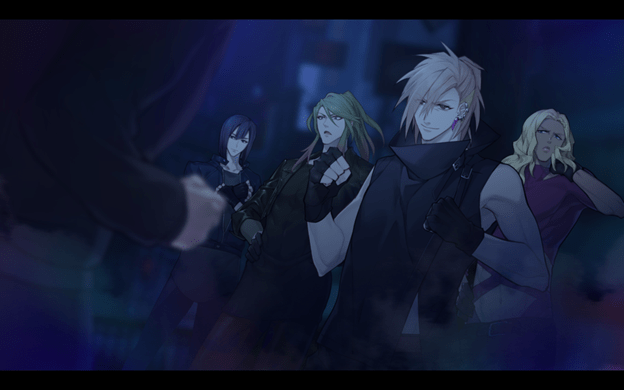
This might be a nitpick, but no matter which character, all of them expect Towa to be monogamous and treat his hard sub stuff as something he should grow out of, or at least share with traditional romantic sexual expressions. This element and some head-tilting gender messages in Rei’s narrative feel unintentionally conservative in a game with cosplay sex and knife play. Thankfully, as referenced earlier, Slow Damage does the impossible and writes each love interest as people who would love Towa, for different but justifiable reasons. Towa acting as a sexually limitless figure does feel like the game is trying something different, but also feels like the game is having its cake and eating it too. Madarame, a Go-Nagai myth more than a man, was enjoyable, but would feel as if a literal wolfman was on the Bachelorette if kink boy Towa was not the protagonist. While the overarching story does not get to the childhood trauma firework’s factory until the last route, and everything before and after Madarame’s section are more realistic, Madarame does occasionally knock the door to the “this is a sex game that follows specific tropes” room. Slow Damage, for being so long, never feels as if it’s wasting time.
Pros: Fantastic game about people trying to survive a near-future New Vegas and how damaged people interact, be it building up or tearing down. Towa’s proclivities do allow for the sex and general explicit material to be harder than the average for most sex games. It’s mostly handled rather respectfully, the unintentional conservatism aside, and is refined enough to not feel edgy in a tasteless way. A high standard in protagonist writing and extended cast characterization and overall visual storytelling that might be Nitro Chiral’s best work.
Cons: Investigation and interrogation sections are an attempt at something new, but are a needlessly confusing addition to what is effectively a linear VN. Slow Damage makes the Yakuza characters charming and fun to watch, but from time to time, they will remind the player that they will run down debtors in the middle of the night and kick them till they pass out. Even with it succeeding at not feeling tasteless, Slow Damage will be too much for some players.
JAST Blue sells Slow Damage on their site for PC. Slow Damage having a VN protagonist in Towa, who is an actual character and not a faceless player insert makes it remarkable. The fact that this game has a strong protagonist and excels in other places most where other VNs struggle, looks like a big budget production, and has a beautifully sad ending, puts Slow Damage in a category of mandatory VNs.
 Oddity Games
Leave a comment