Story runs in DotAGE are long, with both of my attempts lasting over nine hours each. This is longer than the typical much shorter runs common in other roguelikes, which for me usually end in an hour.The games’ hints and tutorials heavily recommend starting a village over from the beginning. I started on the second easiest difficulty, and even then, tough decisions had to be made. For example, random Pips will stop by and ask to join the village. If things are not going well, that Pip is just an extra mouth to feed and might be pushed away, their thirty apples stolen to feed the village.
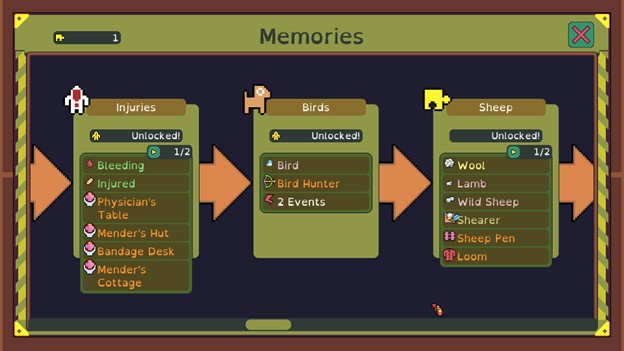
Even on the easier difficulties, DotAGE can be stressful. As an experiment for the second playthrough, the easiest difficulty was used to test if DotAGE was worth playing for someone who was more interested in the lizard-brained task of upgrading buildings and unlocking memories. Memories are the game’s progress system, where the elder recalls aspects of life, from mundane things like the existence of pigs to complex ideas like the concept of grief. It’s akin to the dork in a sports manga that knows all the terms and plays who manages the protagonist, who is naturally talented at pitching even though they’ve never thrown a ball. Leisure can happen in the easiest difficulty, which is why it was so easy to lose hours at a time to j pecking away at forests and building niche amenities (one is a Japanese restaurant which requires a designated sushi chef Pip). A balancing problem with the memory system is that certain live resources would not spawn, even when given access to them. For instance, fish huts could have been built in the first playthrough, but fish themselves were not present. The end game big event, which will not be spoiled here, even in the easiest mode, still requires a grasp of the different systems a fifty plus member village requires to function. The game is intended to be played over and over, with the motivation for further stories involving new elders to use and different cultural settlements to build.
In roleplaying, wisdom dictates that what happens to a player is often more interesting than the complex background of the character themself. The classic “I do not care about what kind of high magic your mage can cast, but I will listen about how your party has an inside joke with how your frog barbarian would soak his green feet in the communal soup:” DotAGE is just like that, a unique recollection of trials and tribulations of a colony of people who did or did not survive. What sticks are events like how one of my carpenter’s got a taste for murder after killing a fellow Pip during an argument. Or how during my first run, I had Pips get so sick, they had explosive diarrhea, which was after half the village burned down in a fire. Rebellions and small worker revolts would happen, where the only cure was sending Pips to the knife master to be entertained with a literal “bread and circus”.
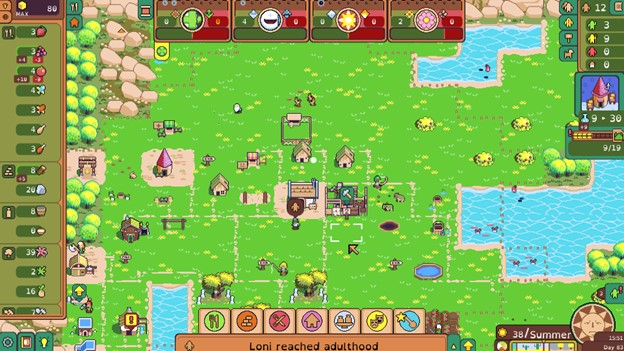
DotAGE’s systems are more complicated than its visuals, but what visuals are present are charming. Pips wave around their noodle arms and wear different theatrical hats for each profession. The hats often replace a Pip’s hairline, so when it gets windy or they shake their hat to show that it is hot out, they temporarily lose everything. I like when they laugh out loud at something marginal, and their mouths take up most of their small faces. The buildings are cute, and with a few exceptions, convey their intended use. Especially the late game buildings like the theater or the bath houses. This visual flourish is super helpful when many buildings must be built alongside each other and become cramped areas of an already small map.
Pros: Easy-to-learn, complex-to-master game loop where it can feel like life or death really are in your old sagely hands. Includes some means of difficulty scaling for those present who do not excel at strategy games. An objective-focused campaign that judges not only player action, but reaction to problems as well.
Cons: Little, if any, music outside of larger events. Certain rewards feel imbalanced against their tragedy counterparts, with some so situational they might as well have been skipped. The pressure can become unpleasant instead of motivating, especially with some of the tougher events that cannot be influenced. Story campaigns feel so long that the skip animation buttons should not be so necessary. Obtuseness in determining it was possible to retrain Pips, so certain niche Pips felt less universally useful than others (for instance, the ice carver).
DotAGE is currently available on Steam and Michele Pirovano regularly provides free updates to the game. It wouldn’t be surprising if someone spent a lot of time in DotAGE, or picked it back up between other games, and for a certain person, this could be one of their favorite games. I enjoyed my time with DotAGE, but I probably will not return to it for fear of how it causes minutes to turn into hours.
 Oddity Games
Leave a comment