

DotAGE is the long-term passion project of sole developer Michele Pirovano, following a village elder’s recollection of how their village got its start. A village simulator with a roguelike system involving perma-failure states and new “runs”, Pirovano’s game about village management r had my attention when he described it as having “worker placement mechanics inspired by board games”. Historically, worker placement games are set in pastoral plains and fields filled with farmers and laborers (Rock Hard: 1977 for instance, stands out from worker placement games simply by changing the theme to 70’s working-class rockstars), so a game focused on resource management with limited actions was worth trying.
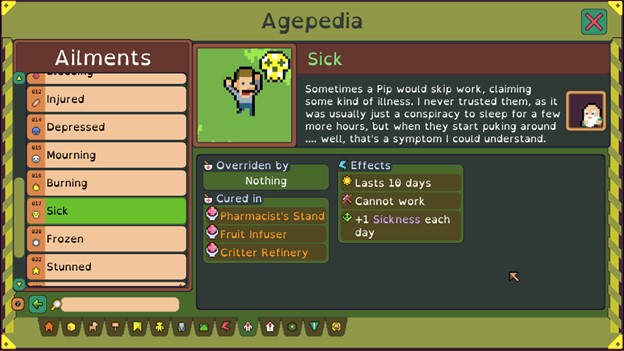
DotAGE’s gameplay difficulty is not centered on reaction speed or memorization but complexity that requires more foundation-laying than is usual for one of these reviews. Every day, or turn, the village elder has limited ‘Pips’, DotAGE’s goofy non-humans who can reproduce in a day and quickly grow to adulthood Pips can be assigned tasks, ranging from berry foraging, beer brewing, and even curing complex diseases. Pips start as handymen but can be taught professions, such as fisher, scholar, and theater performer. Each campaign is called a ‘story’, starting slow in spring but going up to winter of the next year. Keeping Pips housed and fed is manageable until real chaos starts to disrupt the community. Four Domains: Health/Sickness, Hope/Fear, Heat/Cold, and Nature/Cataclysm are gauges that must be maintained as the village elder predicts omens and drastic events. While many of these mishaps can be mitigated and fought, such as building temples for prayer or stocking to increase the heat during frigid seasons, sometimes bad events just happen. As in real life, five people might get stunned for ten turns or fields get flooded.
 Oddity Games
Leave a comment