
Affogato swaps this structure by keeping enemies static while moving units around a map like train tracks, or those mine carts areas in the GBC Legend of Zelda games. Returning to that Persona reference, all units are based on tarot cards that are played from the hand and can be leveled up. For instance, Chariot is a defender, Emperor assaults, and Hierophant is a vanguard (the game assumes the player knows what a vanguard unit does, which is generating deployment points to play other cards, something I’m familiar with because of Arknights). Most stages require defeating a mini-boss or moving an object to the end of the track. The other half of Affogato includes time-managing the coffee shop, increasing relationships with customers, and reminding Mephisto to wash the dishes for the fifth time.
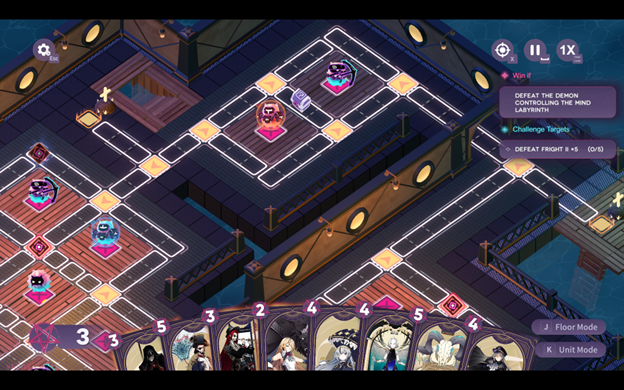
The reverse-tower defense is initially clever, but jumps around in difficulty. Even playing on easy, certain stage mechanics, like the impressive ability to jump between above-water and underwater sections of the map, shift the game away from strategy to single-solution puzzles. The difficulty comes from the game’s removal of air pockets from underwater stages, which damage units after a certain time underwater. Plus, jumping between map sections in these stages requires managing limited cards, so in certain stages, the run becomes unbeatable from running out of cards. This happened enough times during the end of one character’s story that a Steam achievement for “complete a stage after restarting ten plus times” mocked me for taking forty minutes to beat a four-minute stage.
The tarot cards have a ten-level limit and, because the game restricts the use of vanguard characters and reduces map deployment currency, stages can go from easy, to hard, to easy again, to hard, in a drastic difficulty swing. Plus, the game only has three different stage types to swap between: standard, underwater, and delivery. Arknights, by comparison, because it is updated regularly, provides new stages that focus on new stage hazards or environmental objectives. It feels great to power through a stage with a conga line of six cute tarot cards warriors blazing a trail, but certain stages can be failed because the right path was taken instead of the left.
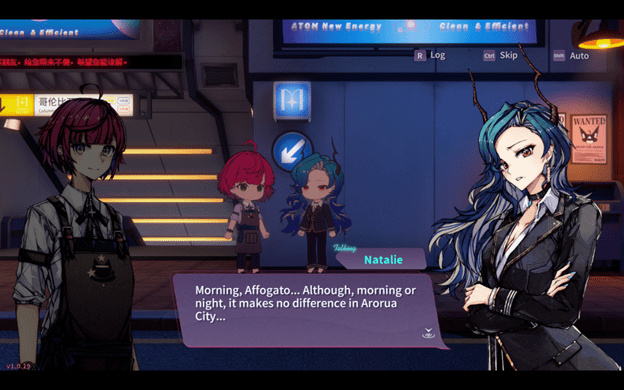
Affogato’s daily schedule of making coffee, eating hot-pot to increase her courage, and visiting Arorua’s oddly limited locations (the asset economics causing the game to frequently take place in a hospital or a high school comes off as charming instead of resource-strapped) are where the real themes and personality reside. Affogato, past all the demon possessions and making Americanos for detectives that talk TOO MUCH, is a game about late-stage capitalism, economic recessions, and how these factors specifically target women. Affogato’s first new customer is Natalie, a laid-back, off- beat reporter who shifts careers to writing and recording fake urban legend and ghost stories, where she has to self-insert herself as an idol. Natalie feels her niche job is belittling her as a serious journalist, but she must also compete with other women in a tiny pool of click-through based content farms. Other women Affogato help is an office worker who leaves her job because of sexual harassment, and a video game development group whose founder was scapegoated into being fired from a previous project. Certain women feel like they were taken straight from the 90’s recession hell depicted in the manga and anime Kaiji, and are rightfully angry at the kind of labor expected of them. Time is spent commenting on male labor as well, with the concept of a corporate culture that does not promote men who are not visibly dating or married to a woman.
This kitchen sink approach to a game demonstrates, if nothing else, ambition. Affogato’s two lanes of gameplay, coffee sim/time-management RPG and reverse tower defense, maintain similar amounts of enjoyment, but also a specific problem: one genre execution is objectively worse than the other. The story will interrupt the day-by-day schedule, wherein Affogato will wake up and is abruptly flung into a mandatory battle. The few legit bosses are given forewarning, but sometimes two days in a row might be out of the player’s hands. Side stories revolve around relationships with given characters, and Affogato is nice enough to prompt when the player has a gift to move things along. This does not apply to Affogato’s three character attributes, which are only explained as necessary for progress late into a side character’s route. The first hour has some glaring grammatical errors and a potential translation issue where characters use the term “sour” as a positive attribute to describe coffee. Sour coffee is usually an indication the beans have gone bad, and quick googling didn’t resolve this as a cultural difference. If this was another way of saying “acidic”, it ended up unintentionally funny.
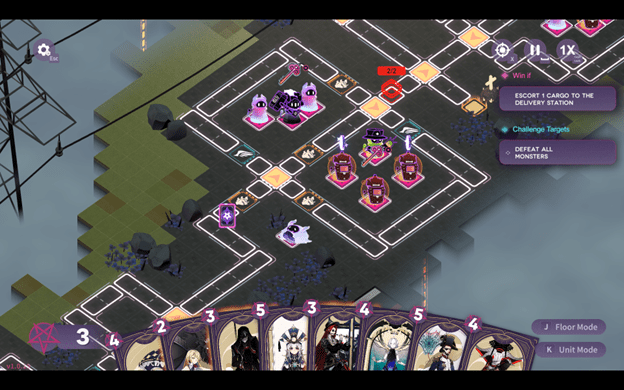
Combat difficulty and path-making stems from avoiding two laser enemies, with the remaining demons being extensively the same characters, albeit with different color palettes and increased defense. In the middle of combat, clicking and dragging a card from hand to field often involves mis-clicking and over relying on the pause time function, especially while tracking multiple enemies and pathways. The reverse-tower defense premise is engaging enough that future new mechanics would be worth replaying stages, but by narrative’s end, the few mechanics presented had bottomed out. A similar example would be getting tired 3/4th of the way through an Ace Attorney trial, where the freshness and novelty of a new cast of characters and locations can wear off if the chapter’s writing isn’t especially strong.
Affogato’s aesthetic choices and attention to visual detail win over the two gameplay modes’ clear issues. From a load screen of star-shaped sugar cubes being flung into a coffee cup , to the unique art on each tarot card divorced from the game’s characters usually look, to redecorating the café into a 1950’s Americana diner or a dark academia lounge, Affogato’s visual flair balance out the annoyances. An entire section is even one long Death Stranding-themed homage, so it is hard to be too grouchy.
Pros: Generally succeeds, as a coffee-themed game that balances introducing new mechanics in reverse-tower defense, with a time-management game. Great depiction of the hell not focused on biblical demons, but the real hell of late-stage capitalism and how it treats women workers. Great overall visual aesthetics and design details.
Cons: New combat gameplay has potential, but runs out of new changes and enemies. Inconsistent difficulty, even on easy mode, with strategy sometimes replaced with single solution puzzles. Does not explain the limitations and directions for the time-management sections well for a story that only takes two and a half-in game months. Translation, specifically in the first few hours, needs another editing pass. The shop sim will not let the player serve the wrong coffee to a customer and there seems to be a bug where the best social answer to pick is the top one of two responses.
Affogato is flawed, in both its combat and time-management halves, and has some noticeable technical issues. But it is memorable, with different gameplay modes, a late-capitalism recession narrative, and attractive visual style, to be worth playing. If Affogato had a DLC case where Affogato and Mephisto resolve a dog woman’s demon problems at her ride-share gig, I would certainly not turn down the opportunity.
 Oddity Games
Leave a comment