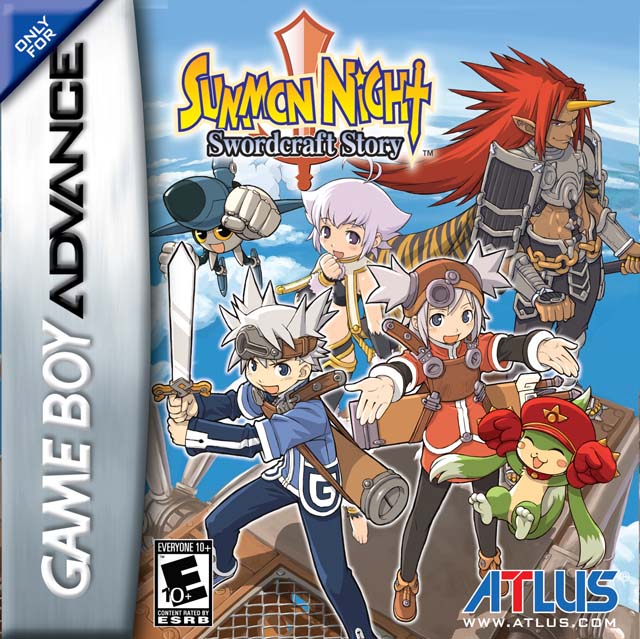
Summon Night: Swordcraft Story was originally released in 2003 and localized by Atlus in 2006. The game is an action RPG spinoff of the tactical RPG series Summon Night, and received two sequels, creatively named Swordcraft Story 2 and 3. The majority of the Summon Night games never received localizations, barring the Twin Age spinoff, 5 and 6. The game was developed by Flight-Plan, a now-defunct development team that also worked on the Japan-only series Black/Matrix as well as some stand-alone games like Eternal Poison and Sacred Blaze. The game’s character designs were done by Kouhaku Kuroboshi (using the name Takeshi Iizuka), who also did illustration work for the Kino’s Journey and Gun Gale Online light novels, as well as the design for vtuber Ninomae Ina’nis.
Swordcraft Story takes place in the country of Wystern, a steampunk-esque fantasy land overseen by Craftlords, talented individuals capable of forging powerful weapons. A tournament to determine the successor to the title of Craftlord of Iron is being held, pitting the youths of the two swordcraft guilds against each other. The protagonist (Cleru or Pratty depending on gender picked) is the child of Shintetsu, the previous Craftlord of Iron, and legendary hero who sacrificed himself to protect the country. Seeking to follow in their father’s footsteps, the protagonist must participate in the Craftlord tournament, aided by their mentor, Bron, and one of four Guardian Beasts, determined by a personality quiz early on in the game. As the story progresses, however, the frequency of natural disasters in Wystern and turmoil between the Craftlords make it clear bigger issues are afoot.
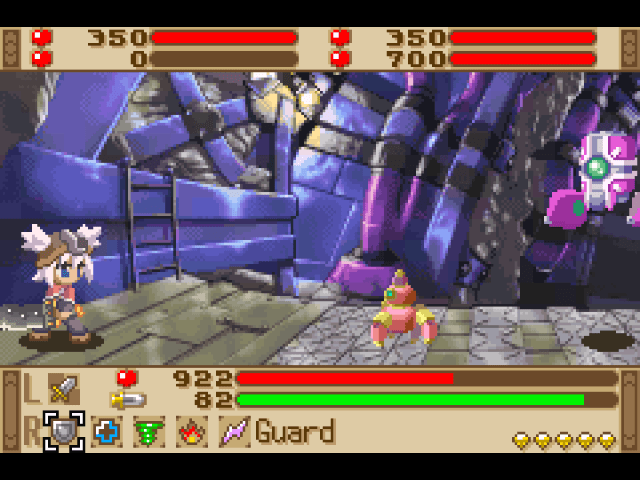
Swordcraft Story is a 2D action RPG that plays similarly to early Tales games. Fights take place on a horizontal plane, and the player can select between several weapon types to utilize during fights. The protagonist can equip up to three different weapons plus one accessory – no armor or other defensive items in this game; however, during tournament boss fights, the player can only select a single weapon. Each weapon type has its own strengths and weaknesses. For example, swords are fairly balanced speed and damage-wise, but have low durability, spears are slow but have the longest reach, and drills have short range, but can wear down opponents’ weapon durability quickly. The protagonist can also summon their Guardian Beast in battle to cast offensive magic or support spells, though magic can only be used a certain number of times before the player needs to heal up.
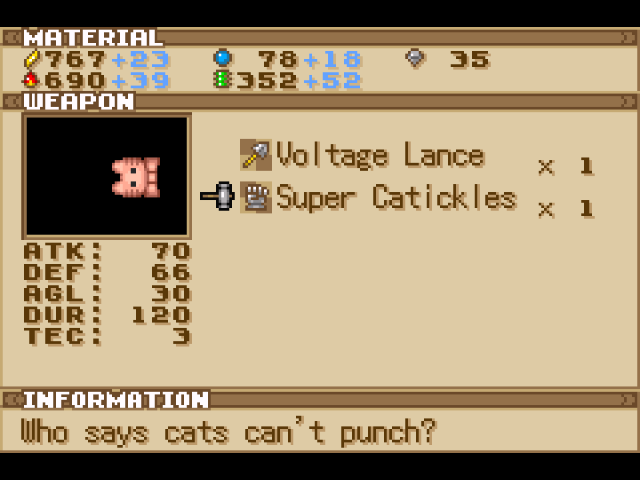
Much of Swordcraft Story involves dungeon crawling and, well, crafting swords and other weapons. The story is split up across multiple days (to clarify, the “days” are basically individual chapters; this is not like the Atelier games where in-game action makes time progress), usually involving the protagonist involved in some shenanigans, traversing some dungeon floors to fight baddies and collect crafting supplies, tossing the supplies in a forge to make pointy things, and fighting a boss battle or two. The crafting system is simplistic: recipes can be obtained from Bron, completing side-quests for various Wystern denizens, or breaking opponents’ weapons. The supplies to make weapons are usually obtained from smashing crates found within dungeons or by recycling obsolete weapons. Interestingly, crafted weapons can’t be upgraded; instead the player is encouraged to craft newer, stronger weapons. The game also has some dating sim-esque segments at the end of a day, where the protagonist can spend time with an NPC. Usually this opens up some dialogue where the characters will chat and comment about the story’s events.

Swordcraft Story feels like the platonic ideal of a handheld RPG. The game takes an action RPG battle system and crafting mechanics, but tweaks the formulas to work well within the limitations of the GBA. The game feels breezy but not slight; it embraces simplicity and still feels very satisfying to play. I played a significant amount of Swordcraft Story on my work lunch breaks and coffee shop trips and always felt like I was making some sort of forward momentum instead of being stuck in some sort of grinding-purgatory, which sometimes pops up when I play much longer RPGs. Playing for longer periods of time does make the game feel a touch repetitive, not helped by the game’s more unique dungeons being one-off visits, so you’re stuck with the monotonous main dungeon for most of the main story. The game also has a glaring issue with sidequests: they have to be completed within a given “day” or you’re locked out of them forever. I screwed up a lengthy sidequest chain very early on since the game doesn’t communicate this matter. It wasn’t a huge deal since the game as a whole isn’t very hard, but it is annoying.
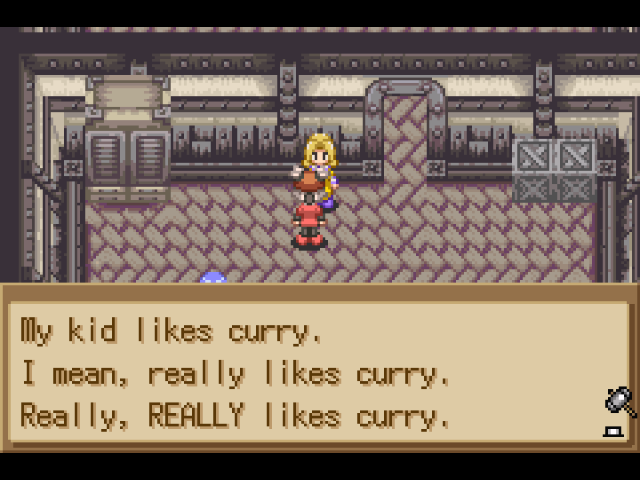
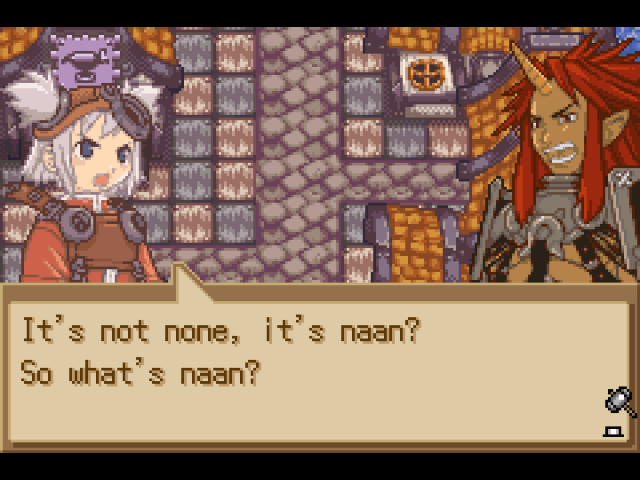
There’s a sense of genuine coziness in Swordcraft Story that I wasn’t expecting for an action game that’s not only enhanced by the gameplay loop, but also the game’s writing. The overall plot of the game isn’t particularly original by fantasy RPG standards, but the character interactions are pretty great. There’s a mid-game chapter where the protagonist “trains” under Craftlord Sakuro that ends with them unknowingly making him curry, which got a good laugh out of me. I also deliberately looked up answers for the Guardian Beast quiz to get fire oni man Rasho, and he’s an absolute riot – usually providing unfiltered sass towards the protagonist but also being oddly reserved around the protagonist’s mother. I’m not sure how much of the character writing was potentially enhanced by Atlus’s localization, but there’s a lot of funny moments in the game, even with some of the unnamed NPCs hanging around Wystern. In comparison to GBA RPG darling Golden Sun, which has some of the blandest dialogue wherein characters use too many words to discuss simple concepts, Swordcraft Story feels like it has actual personality in its dialogue.
Pros: Action RPG combat is smooth, fluid, and fast. Weapon variety encourages experimentation and flexibility in playstyle. Crafting system is easy to utilize and doesn’t get bogged down with excessive material grinding or min-maxing weapon stats. Dialogue is genuinely funny and the dating sim-esque end-of-day hangouts provide extra insight into the NPC’s personalities. The game as a whole is cozy and finds strength in its simplicity and breezy tone.
Cons: Gameplay loop can get repetitive if played over long periods of time. Annoying sidequest lock-out that the game doesn’t forewarn the player about. High default enemy encounter rate in dungeons. Dungeon design in general is monotonous. Overall plot is not particularly interesting, but it’s not really the main draw of the game either.
Summon Night: Swordcraft Story was originally available for the Game Boy Advance. Unfortunately, the game has yet to see a port or remake on another console. Because Swordcraft Story and its sequel were late-end GBA localization releases, they likely had small print runs, and the secondhand market for the cartridges go pretty high. I saw both games selling for around $120-$150 at a local used bookstore. It’s unfortunate since the games would probably make for an excellent remastered collection candidate, like the Castlevania GBA collection. Given the obscurity of the Summon Night series itself, and the lack of new games in the main series since 2016, it’s unlikely (but not impossible) to happen. I really enjoyed Swordcraft Story and think it’s an absolute shame that the game hasn’t been ported for a wider audience. Overall, Swordcraft Story is a wonderful RPG in a compact package that strikes a particular balance many games struggle to meet.
 Oddity Games
Leave a comment